
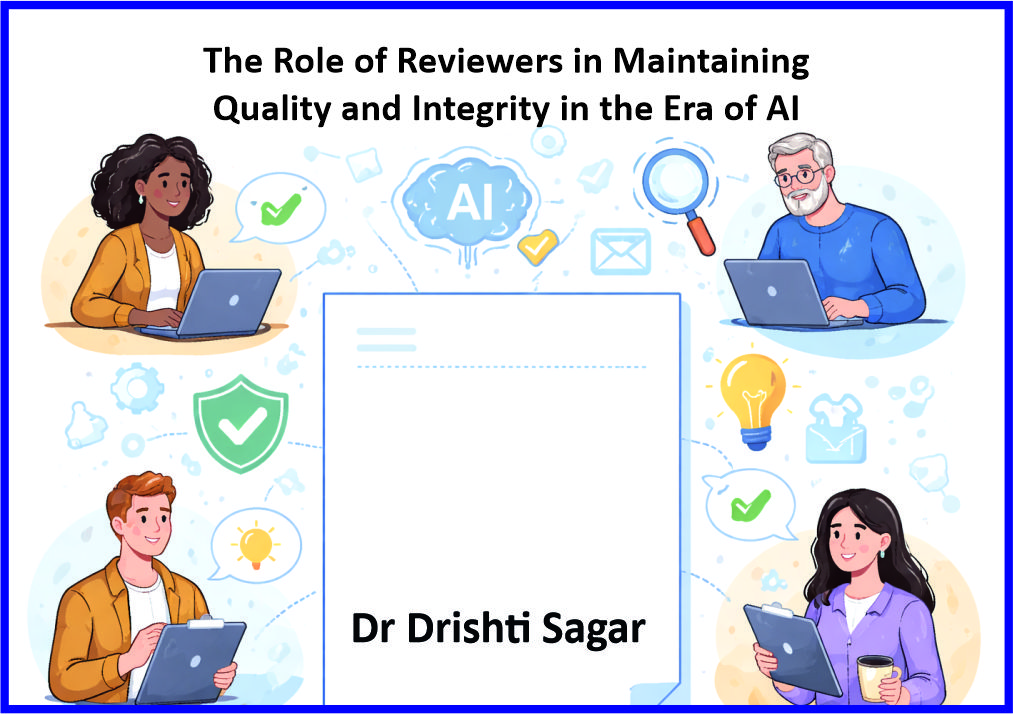
The integration of artificial intelligence (AI) into academic writing and research workflow has significantly transformed healthcare publishing. There is a growing adoption of AI tools for literature searches, data summarization, language editing, and even manuscript generation. Though this technology promises efficiency and ease, it presents new challenges that highlight the crucial importance of peer reviewers and their role in ensuring scientific quality and ethical responsibility.
The reviewers are the primary check against errors and misinterpretations from AI-assisted content, and are custodians of quality, credibility, and ethical responsibility. AI systems produce outputs based on patterns of data, not responsibility, truth, or understanding. These responses may represent erroneous interpretation of results, flawed assumptions, experimental inaccuracies, inappropriate extrapolation of findings beyond the data, fabricated references, and discrepancies in conclusions.
In health care publishing, reviewers represent the human mental filter and capacity for critical thinking to minimize these aberrations. The fluent prose and language generated by AI tools can conceal deficiencies in study design, statistical analysis, and interpretation of outcome measures. A careful, analytical peer review preserves the integrity of medical literature and differentiates quality work from superficially polished, flawed research. The reviewers are domain experts who are able to assess the adequacy of experimental design, control groups, and analytic methods. They evaluate the validity, relevance, and applicability of such content to real-world healthcare settings.
In the AI era, reviewers have another key role to play: the ethical oversight of manuscripts. The question of patient safety, data privacy, informed consent and responsible reporting cannot be measured by test statistics or observed by automated tools alone. Reviewers assess whether studies are ethically sound and whether the authors adhere to regulatory requirements and reporting frameworks (e.g. CONSORT, PRISMA, or STROBE). Reviewers are also the gatekeepers of authorship. Reviewers can help to detect undisclosed or inappropriate use of AI tools, ensuring transparency and accountability in authorship. In an emerging era where AI tools will be used to help write and interpret manuscripts and make editorial decisions, reviewers are not becoming obsolete. Rather, they are the link between evolving technological capability and human responsibility. The evidence published in peer-reviewed journals is used for informing clinicians, policy makers, and patient decisions that can have a profound impact on health outcomes. In an era where AI is becoming an integral part of academic workflows, peer reviewers remain the linchpin for quality control in healthcare publishing.
