
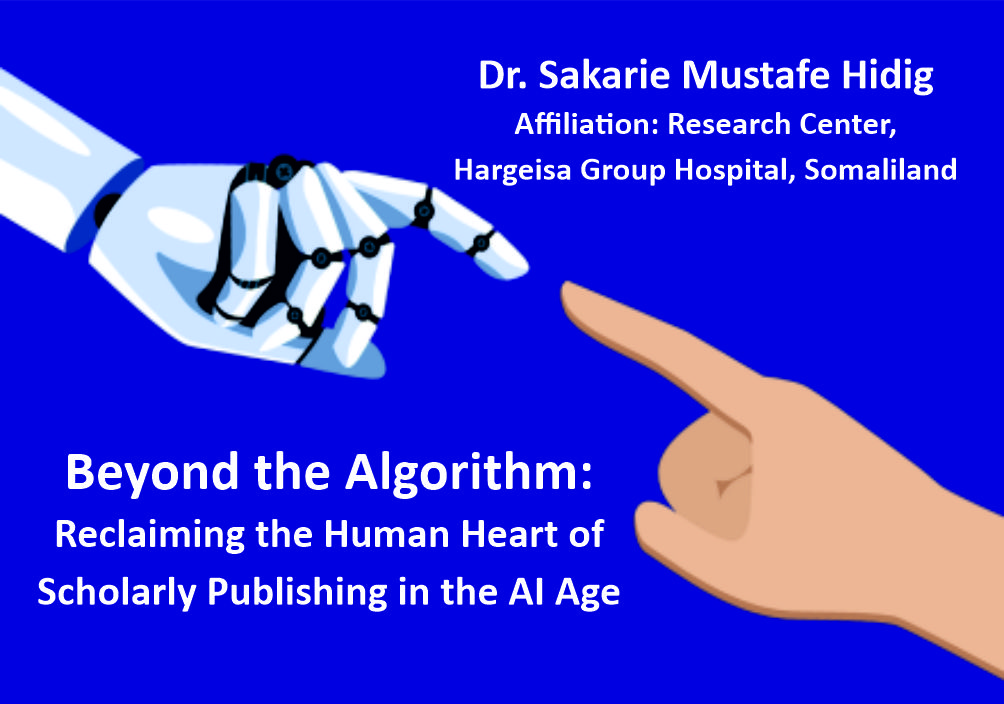
The printing press democratized knowledge. The internet globalized it. Now, Artificial Intelligence is redefining it. We stand at a pivotal moment in scholarly publishing. AI tools draft manuscripts, suggest references, detect plagiarism, analyze datasets, and even generate peer-review reports. Efficiency has never been higher. But neither has the urgency to protect the very pillars upon which academia rests: quality, integrity, and trust.
The question is no longer whether AI belongs in scholarly publishing,it already does. The real question is: Who is in control? Strengthening quality in the AI era requires shifting from reactive detection to proactive design. Instead of merely identifying AI-generated text, journals must develop transparent AI disclosure frameworks. Authors should declare AI assistance as clearly as they declare funding sources or conflicts of interest. Transparency transforms AI from a hidden shortcut into an acknowledged tool.
Integrity must evolve beyond plagiarism checks. AI can fabricate references, hallucinate data, and generate convincingly flawed arguments. Editorial systems must therefore integrate AI-auditing mechanisms tools that verify citations, validate data consistency, and flag statistical improbabilities. At the same time, human reviewers must remain central. Machines can scan patterns; only humans can evaluate nuance, context, and ethical sensitivity.
Most importantly, the future of scholarly publishing must resist becoming fully automated. Knowledge creation is not merely content production. It is curiosity, doubt, interpretation, and lived experience. AI can accelerate writing, but it cannot replicate intellectual accountability.
The strongest publishing ecosystems will be those that adopt a “human-in-the-loop” model: AI for augmentation, humans for judgment. Training programs should educate researchers on responsible AI use, not prohibit it. Editorial boards should diversify technologically while preserving ethical oversight. Institutions must reward originality of thought, not volume of output.
AI is not the enemy of scholarly publishing. Complacency is.
If we design systems that prioritize transparency, embed accountability, and preserve human oversight, AI can elevate research quality rather than erode it. The future of publishing will not be defined by algorithms alone but by the values we choose to encode within them.
In the end, safeguarding scholarship in the AI era is not about controlling machines. It is about reaffirming what makes research human.
